

on loving poorly
a reflection on the mistakes i've made in love & limerence; lessons before marriage

“Love alone is credible; nothing else can be believed, and nothing else ought to be believed.” — Hans Urs von Balthasar
“a spiritual master of the middle ages, says in a cryptic Latin phrase, Ubi amor ibi oculus — “wherever love is, there the eye is also”, which means that the lover is the only one who really sees the truth about the person or the thing he loves. It is the perfect complement to amor caecus est, another more famous phrase, that “love is blind”—blind to all this lying world because love sees only truth” — John Senior
“Whoever wants to become a Christian must first become a poet. That’s what it is! You must suffer. You must love and suffer—suffer for the one you love.” — St. Porphyrios
I am getting married next month, at 26—the same age my grandmother was when she tied the knot. How trad, right? No career, no license, only a fiancé and some scattered dreams. Except, I am the furthest from a tradwife; I met him on Bumble. To be fair, neither is my grandma. She’s a day trader and a genius, despite never having received a formal education. A tradewife, if you will.
My fiancé and I joke that Peter Thiel must have stolen our data to arrange our marriage, because we have so much in common that our union seemed improbable. A match made in heaven? No, on Palantir. However, I’ve often been skeptical about my ability to make it through various rites of passage. A part of me didn’t think I’d graduate high school, let alone get a master’s degree. Still, I’ve been through enough to believe that God will hold your hand through anything if you ask. This year, I’m grateful to have expanded my view of what love looks like.
After a lifelong struggle with a level of platonic closeness I always craved but never reached, out of fear that I’d be too much, I finally have friends (thanks to Alex) with whom spontaneous sleepovers are the norm, not reserved for special occasions nor seen as an inconvenience. As I grow, the more I appreciate precious time spent in community and admire those who fight to make it happen. They impress me as a byproduct of being themselves, encouraging me to become a better person and never to despair. How lucky am I to envy people in my life not for their riches or status signals, but for their abundant, overflowing generosity?
These friendships, alongside the steadfast love of my fiancé, have transfigured and nourished my soul. I move through the world with a strange, overwhelming surplus of exuberance and gratitude. Sometimes I’ll be wanting to hug everyone I see, in recognition of their divine inner light and the miracle of consciousness. I’ll pass by strangers imagining what they might’ve been like as children, grasping more and more what agapé love entails. However, the road to my marriage and social circle hasn’t always been a fairytale, and I don’t expect the continuing journey to be easy.
Before becoming a wife, I’ve decided to reflect on the winding path I’ve taken towards love. I’ll spare you the saccharine clichés about marrying my best friend, and will be intentionally leaving out important details of the most sacred of loves, as all true lovers know that the most intimate treasures must be kept confidential. The etymology of ‘taboo’ comes from the Tongan tapu, meaning sacred, forbidden, set apart. I could write a whole memoir about my convoluted history, but would have to publish it posthumously in order to hide from public shame. Instead, I’ll divulge the truths I’m willing to share as an unreliable narrator.
Although I’ve always felt deeply, I was a late bloomer in the realm of romance and never understood pursuing it for its own sake. I never dreamed of a perfect wedding day. The most sobering advice I’ve received from a friend during my ‘bridal era’ is that your wedding day shouldn’t be the best day of your life, because that would mean the marriage would be going downhill from there. This resonated with me and my fiancé, since we share the intuition that having superbly high expectations for one event is 1) a recipe for self-inflicted disaster, and 2) very convenient for the industry.
I never imagined falling in love at first sight. I could only do so if we met at an animal shelter while volunteering together, or at a bookstore where my lover happened to be holding tasteful works of literature. I never made lists of traits in a dream husband, partially due to low self-esteem and distrust in the inherent hubris of demanding a real person fit my arbitrary, idealized checklist. Little did I know that God would end up surprising me, exceeding all expectations, giving me more than I could ever ask for. His plans are far richer than my daydreams.
“Why do you want a boyfriend?” I once asked my older sister’s best friend, to which she responded with something like “don’t you? It’s cute, I’m a romantic. Boyfriends get you flowers, plan dates, spoil you with love and they become your person.” I mentally assessed it as one of those things I’d only understand when I got older. I did develop a crush on a boy who would post thoughtful little essays on Facebook—come to think of it, this foreshadows my story as a lifelong poaster.
I thought I was a lesbian at some point. My early adolescence was a series of engagements in ‘compulsory heterosexuality’ as a way of connecting with other girls my age. For instance, when people asked me who my crush was, I’d pick the male sibling of a girl who I thought was pretty. That should do, I thought. In hindsight, I think I was performing compulsory homosexuality to impress my online Tumblr friends. Allegedly, there were rumours that I was in love with my best friend. What did y’all think being a ‘girl’s girl’ meant? Vibes? Papers? Losers.
It was not until university that I realized that the love I hungered for was different; I could not know that it existed before tasting it. The way I loved my friends was a dutiful, stable kind of love based on mutual reciprocity and commitment. I could befriend anyone, so why couldn’t I choose to fall for anyone? I assumed this would work for most people, hence the “plenty of fish in the sea” platitude that is commonly offered as advice after breakups. But nobody benefits from this trite, useless saying! Most of the fish have eaten microplastics anyway. Pearls, however, are extraordinarily rare.
So, something was missing. For me, romance involves soul connection and genuine compatibility—spiritual, intellectual, artistic, bodily, intuitive alignment. I didn’t have high standards, per se, just strange ones—rather fittingly, as a peculiar person. Perhaps this will only make sense to fellow peculiars, but I pity people with this “plenty of fish” mindset which implies that people are replaceable (though arguably, their love is more ‘pure’ than mine as they could see the beauty in anyone, and everybody is an image-bearer). I took pride in my ability to fall in deep love, to discover a universe in the particularity and elusive beauty of my beloved, while most the world could only view them through flattened lenses.
During my first year of university, I suffered from what I’d known as “oneitis” (psychologists call this “limerence”—fun fact: Chopin also experienced this; he barely spoke to his crush, but obsessively wrote to his friend about his “miserable and infirm enthusiasm”). We shared uncanny interests and odd biographical details, yet contained enough polarities to make the dynamic feel alive, continually surprising. The second time we met, we spent more than an hour on a bus-ride in a conversation that felt like home. He gave me a dollar for every rock band I could name that he didn’t know. We ended this game at two dollars, as he realized he’d quickly be going broke.
We were each other’s answered prayers (he asked God for a girlfriend; I asked for connection; both of us were humbled). Our little dalliance was like a re-enactment of Adam and Eve’s expulsion from paradise; falling out almost as quickly as we fell in. Yet, I sought pieces of him everywhere. It didn’t help that I kept randomly bumping into him. Pair this with a religious history and a penchant for magical thinking—what you get is a mind that treats every coincidence as a sign. At one point, I was fraught with layers of existential, metaphysical confusion. How could it have meant nothing to one person, yet everything to another? Are we living the same reality?
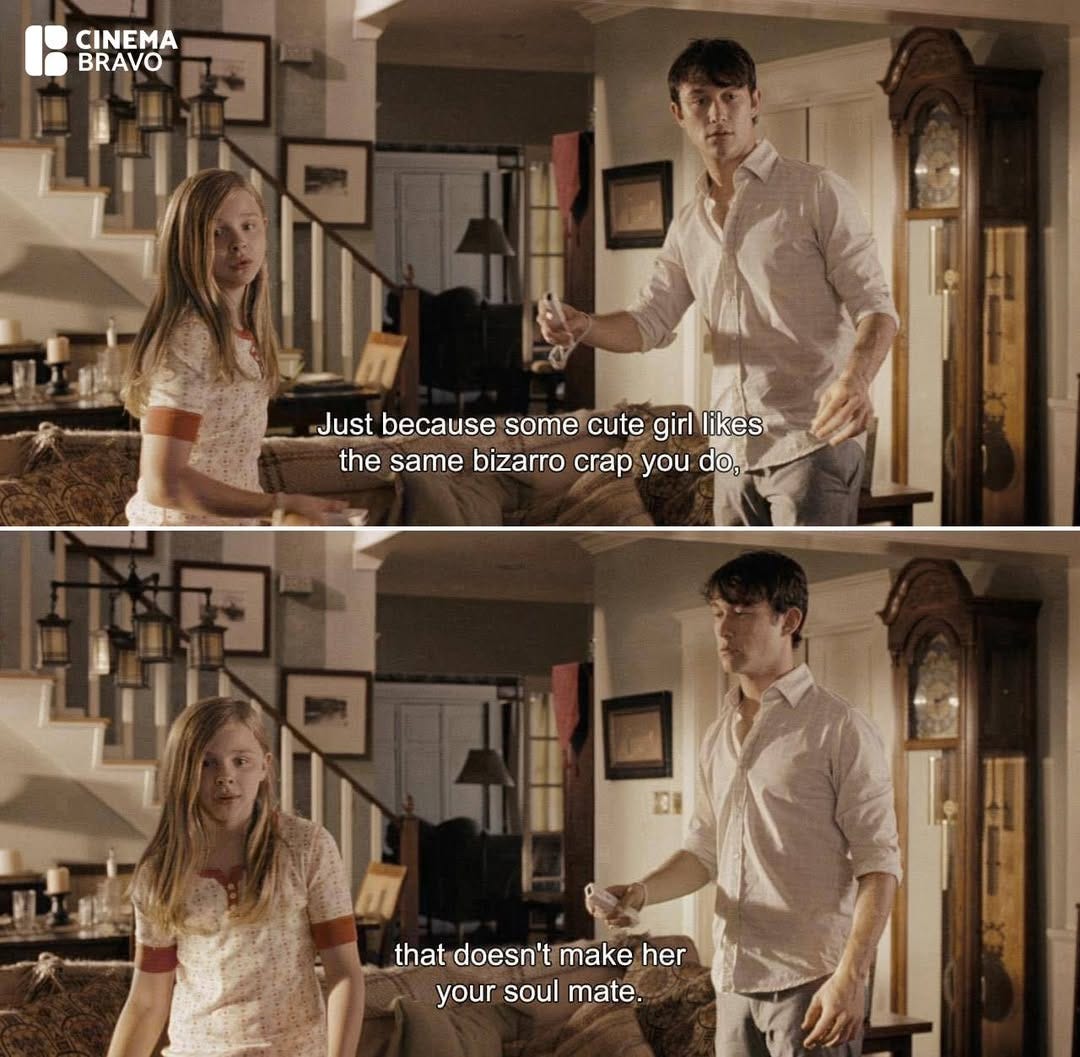
There were ongoing, multi-year-long synchronicities with such absurdity that if I were to pitch the story to a screenwriter, they’d probably say “that’s too on the nose; nobody would believe that”. Synchronicities are shy like that. They’re intensely real only to the experiencer, but seem like a joke to the outside world. I researched the phenomenon of ‘twin flames’ which to my intuition is bullshit, though some anecdotes were eerily relatable. I then realized I was indulging my blindness: if the perception of what makes somebody your soulmate is similarity in values, taste, background, or general compatibility, is it not thinly veiled self-love, masqueraded as love for an other?
On the other hand, I’ve broken at least one heart. This relationship was built on the shaky principle, if you could call it that, of me finding it attractive that he once broke somebody’s bone for being mean to his little sister and got expelled from school as a result. It turns out that this initial encounter was not enough to sustain an intercontinental long-distance relationship. In my sophomoric angst, I tried to prove that we could be the exception. We had similar values, interests, got along well, and we’d come to know everything about each other, but in the end I was not strong enough. The pandemic lockdowns pushed me to the brinks of becoming somebody unrecognizable; isolation stripped away most distractions until I was forced to confront the ugliest parts of myself that I didn’t want to see.
I cried to a poor priest over the phone, asking why his love, devotion, and kindness couldn’t be enough for me. I was told that if he was for me, God would give me the love I needed. I didn’t like this answer and convinced myself that I was incapable of love—if I couldn’t love him, then who? Love was a choice, was it not? So I lived in fear that I’d be doomed to hurt anybody else in the future who decided to be entangled with me. This is probably one of the most difficult periods of transition one can go through. It feels like dying, the sickest betrayal. You blame yourself for being a monster, for abandoning someone who does not deserve it. I’m told that it’s supposed to scar your soul so you won’t do it again.
With time, this experience has not hardened my heart—far from it, in fact. Though it was one of the most difficult decisions, I had been lying to myself and to him for far too long. As Kierkegaard writes, “the greatest hazard of all, losing one’s self, can occur very quietly, as if it were nothing”. Ending it allowed us to make room for the love that truly belonged to both of us, and has led me to know myself and my heart with more integrity. He was a gift that was not meant for me, though I hoarded him unfairly. It is tragic and I wouldn’t recommend it, but wearing this pain, honouring and overcoming it is what’s helped me grow.
When I had unrequited crushes, I’d spend nights spiralling alone in my bedroom, asking why God kept giving me these feelings, despite my awareness that what I wanted was not going to happen, and that my fickle passions would one day pass. Now, I understand that a profound capacity for emotion is a gift. I almost miss the ardent longing and regret the numbness that follows. But limerence is an unhealthy obsession defined by lack (and I do have a tendency to romanticize my pain once I forget how much it was hurting). I was simultaneously addicted to the feeling and embarrassed by it. It was far from love, but a mythologization that, despite the superficial fixation with an Other, said more about me than my muse.
Part of how I healed involved meeting someone else who shared similar experiences with both limerence and love-hoarding, and deconstructing it together, in candour and remorse. We’d both been guilty of using the L word when deep down, we were doubtful. It felt like we were saying it to pass the time. To be honest, I’m still not quite sure what I mean when I say “I love you”, only that it feels right to express it—at times, like releasing the bubble of love inside me that’s so intense and waiting to burst that the only possible thing to do is to externalize it, even through such an imperfect medium as language.
It’s been said that breakups aren’t natural and shouldn’t happen. We never fully recover from loss because love is meant to wound, to change you. I somewhat agree with this sentiment and wouldn’t wish heartbreak on anyone, but I also don’t regret falling hard. I consider it a blessing to have experienced multiple ends of the romantic spectrum from heartbreak, mutual, and one-sided obsession.
CS Lewis writes of romanticism, or the ‘dialectic of desire’, that “this hunger is better than any other fullness; this poverty better than all other wealth”. He continues this thread in another writing: “I doubt whether anyone who has tasted it would ever, if both were in his power, exchange it for all the pleasures in the world”. He concludes that “the experience… never had the kind of importance I once gave it. It was valuable only as a pointer to something other and outer”. It is in the yearning of the unattainable that we begin to catch glimmers of God.
As my beginning epigraphs convey, the act of loving someone is to view them in the same tender light that God sees them—the true light. Of course, only He loves, sees and knows us perfectly. Similarly, St. Augustine writes that “however good a thing is, if it is not loved, it cannot be perfectly possessed, that is, known”. Every attempt at love, every experience I once wished away, ended up teaching me something true. Limerence taught me that even distorted desire can point towards the real. Becoming a heartbreaker taught me the weight of responsibility in love. Friendship continues to teach me generosity. None of my loves are identical, but each has prepared my heart to bring me here.
Next month, I will stand before God and promise to love one person for the rest of my life. I’m entering into this sacrament and new covenant, knowing how often I have loved imperfectly, selfishly, foolishly—because love is the utmost thing worth doing, even poorly ( a la Chesterton’s “anything worth doing, is worth doing badly”). I’ll let the wound of love continue to transform me, not despite its messiness, but through it—echoing St. Porphyrios: “our religion is love, it is eros, it is enthusiasm, it is madness, it is longing for the divine”.
lovingly,
Elysia
What amazing work sister. Surely my favourite article of yours yet. As well as a reminder to rsvp to the wedding!
W love!